Turning Completion into Commitment
Users finished the intake survey and had nothing to show for it. This is the project that changed that.
💬 Some details in this case study have been adjusted or generalized for portfolio presentation. Core decisions and design rationale reflect the actual work.
Project
Intake Survey Debrief
Team
PM, People Analytics, Software Engineer
Scope
End to end
Timeline
Q1 2026
01_Context
The goal was activation.
The gap was the moment right after intake.
The AI coach existed, but low activation and engagement were blocking the business goal of scaling AI driven coaching.
🎯 Strategic Goal
Drive first Ally interaction within 7 days of intake completion
🤔 Problem
No moment to introduce the AI coach or guide users on what it could help with
💡 The opportunity
Intake was a mandatory step for most users, but there was no guided journey after it
User interviews showed people wanted insight from a "coach" right after submitting the survey
02_Gap
The team had a direction. I had a question.
Team's direction
Chat-based debrief
Directly tied to activation and felt consistent with the AI coach's identity. The team aligned on this quickly. It had precedent and felt on strategy.
⚠️ Low engagement in prior product
My proposal
Full-screen dedicated experience
Before accepting the direction, I went back to what we actually knew. Three consistent signals from prior data, session recordings, and user interviews all pointed the same way.
✅ Adopted after evidence review
03_Evidence
Three signals, One consistent direction.
Users who just finished a long survey aren't ready to start a conversation. They're waiting to find out if the effort was worth it.
📉
Prior product data
Chat-based debrief had very low AI coach interaction. Users completed the survey but didn't engage with the chat.
Strong signal
🧪
User testing
Users found the chat debrief hard to understand. The format felt like starting another task, not receiving a result.
Strong signal
▶️
Session recording
Some users spent significantly more time with the traditional report than with the AI chat interface — then abandoned chat quickly.
Directional
💡
Design intuition
Chat feels like another task — not a reward after completing a survey. A debrief should feel like a reveal, not a prompt.
Supplementary
04_Proposal
Design the feeling, not just the screen.
The debrief was structured around one question: what should the user feel at each moment? The surface, content, and interactions all followed from that.
🎉
Beat 1
Arrival
“This was worth it”
💡
Beat 2
Insight
“I understand myself better”
🎯
Beat 3
Action
“I know where to start”
💎
Beat 4
Closure
“I earned something”
💭
To align the team, I didn't lead with screens . I built a narrative around the user's emotional state. That clarity moved decisions faster than any wireframe would have.
Beat 1_Arrival
🎉
Acknowledge effort.
Build anticipation.
After a long survey, the first thing users need to feel is that the effort mattered. We acknowledge that and introduce Ally naturally, before revealing their leadership pattern. The system feels like it's thinking, not just outputting.

Beat 2_Insight
💡
Everyday language.
Real situations.
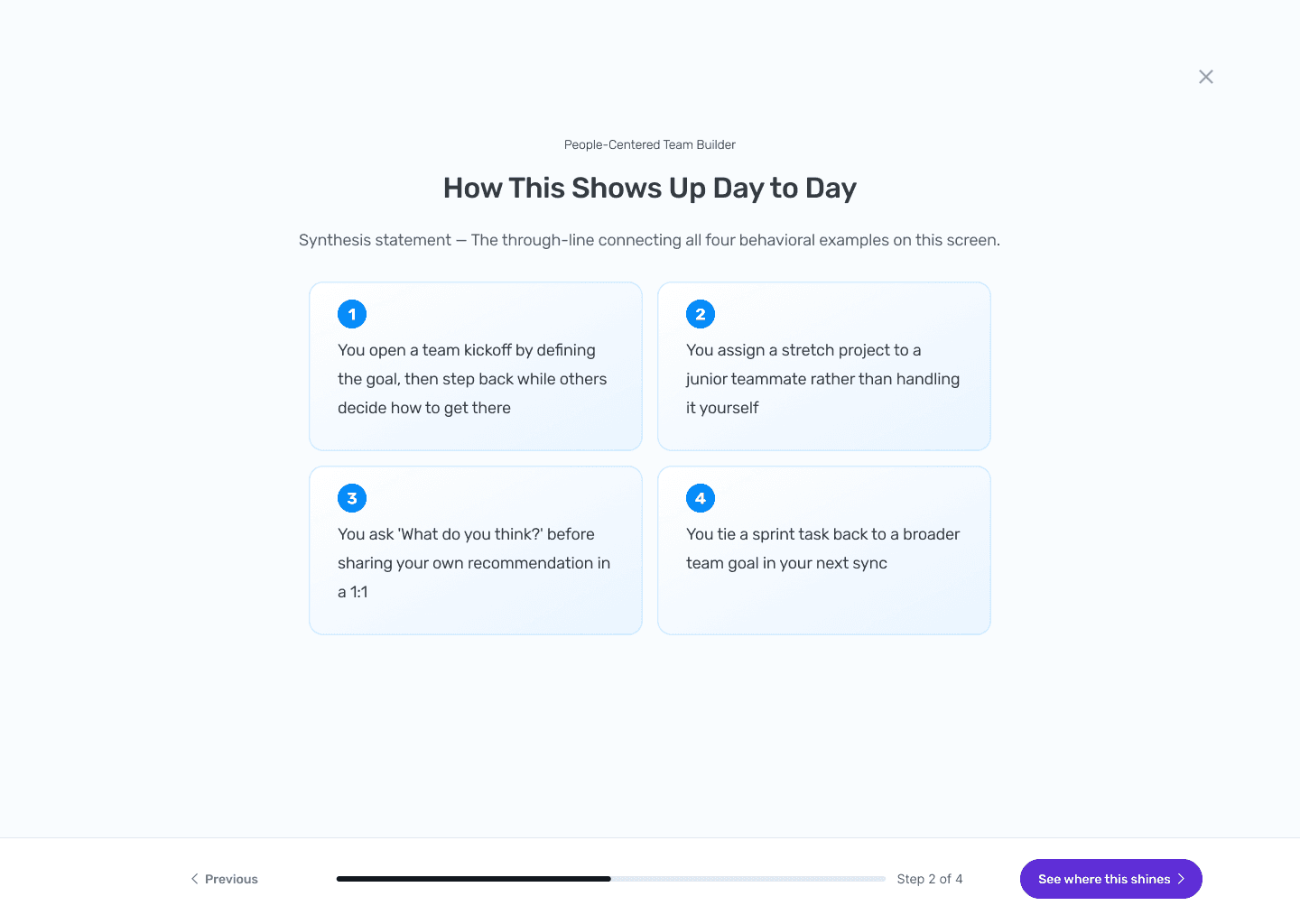
The pattern is explained through behaviors users recognize from actual work, not abstract concepts. Strengths are paired with honest tradeoffs.
Beat 3_Action
🎯
A light experiment.
A coach ready to move with you.
The closing question isn't about goals. It's one small thing to try, framed as an experiment. Low pressure, easy to say yes to. Ally is already in it: ready to remind, coach, and adjust as you go.

Beat 4_Closure
💎
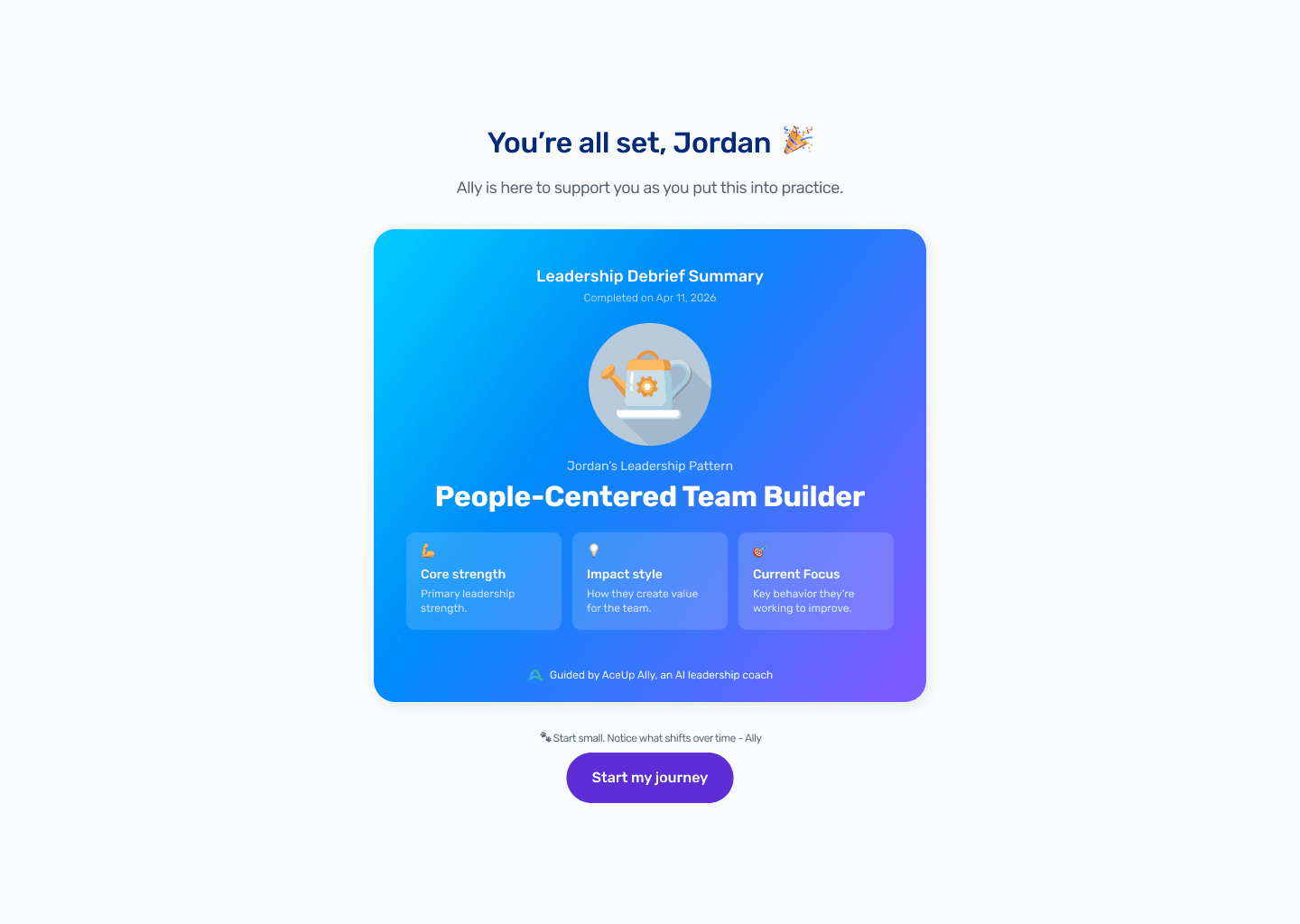
Leave with something earned.
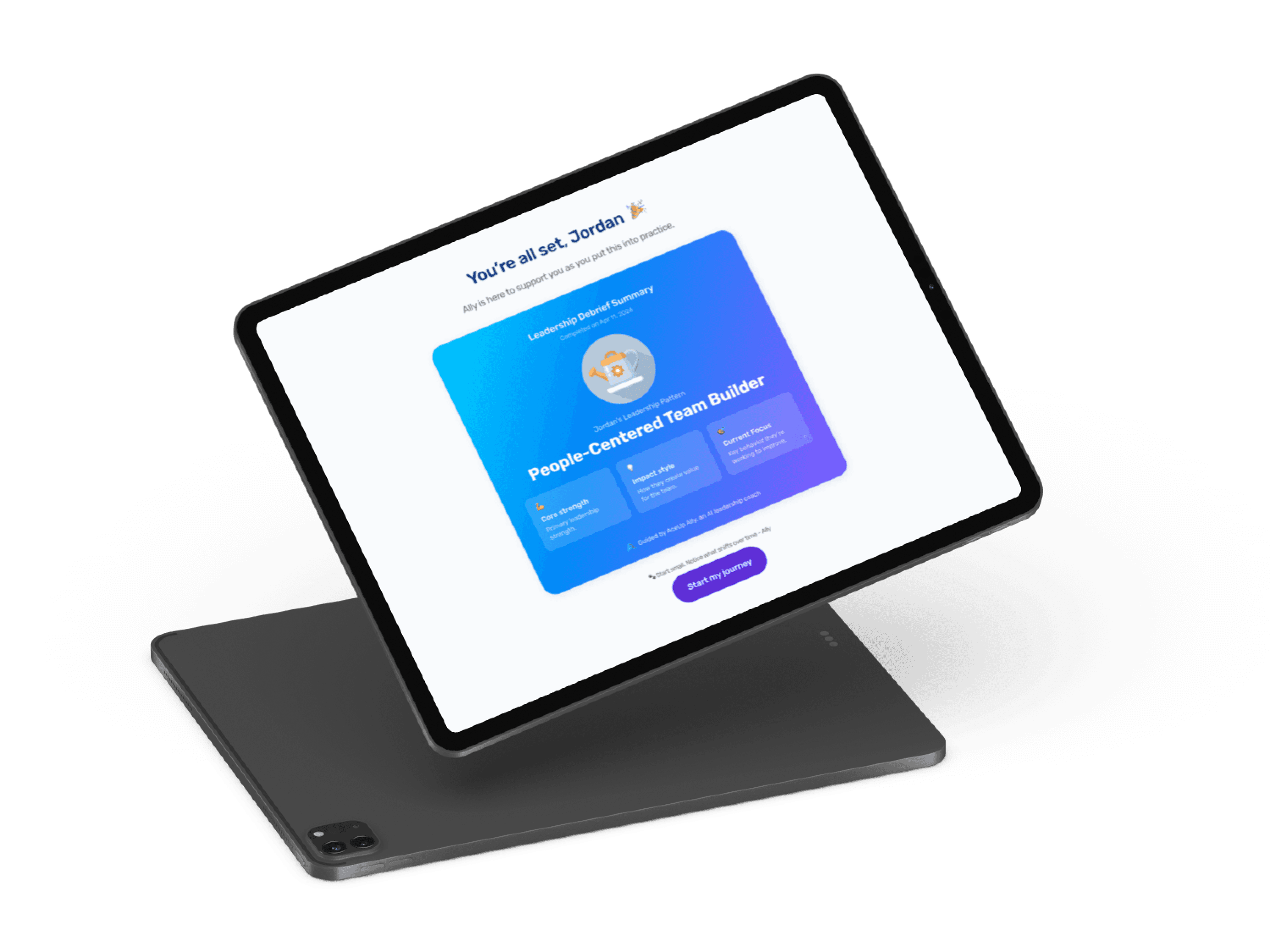
The summary card closes the experience like a certificate: shareable, downloadable, designed to exist outside the session. Something real, not just read. Shareable export deferred to V2; core card shipped in V1.
05_Reframe
The AI doesn't need to be seen to be felt.
The team's concern: without a chat interface, does it still feel like an AI product?
Ally's identity isn't in the chat UI. It's in how the experience unfolds.

Set the AI-led tone: Greeting from Ally + chain-of-thought animation

Core reveal moment: Ally introduces the leadership profile directly.

Bridge to chat: logo + description of how Ally helps with the chosen focus
06_UI Craft
Craft decisions for a dedicated surface.

Gradient
Professional without clinical
The team wanted a premium feel reflecting the AI coach's expertise and approachability. Subtle gradients add depth and warmth where flat color would fall short.

Typography
Hierarchy shapes the experience
Readability is design in a text-heavy surface. Default weights felt too far apart, so both were adjusted: Light 300→320, Regular 400→370. Validated with engineering.

Illustration
Built to sit within the system
No existing illustration style. Neutral blue-gray base with orange accent is consistent with the home's color hierarchy, adding visual rhythm without competing.
07_Collaboration
Cross-functional collaboration was central.
The experience was designed to feel like something you receive, not something you do.
💼
Product Manager
Align before advocating
PM identified the post-intake activation gap as a business and user priority
Aligned with PM on the problem before proposing a different surface
Outcome: The proposal came with shared context, not as a solo pitch
🧠
People analytics
Co-design the narrative
Explored formats for surfacing survey insights with existing data. Landed on leadership patterns
Content shaped by psychology expertise, in workplace-grounded language over academic framing
Outcome: Archetypes that felt grounded and immediately recognizable
🛠️
Engineer
Validate feasibility early
Included from the start, before design decisions were locked
Validated both surface proposals for technical feasibility
Reviewed animation complexity and edge cases before committing to build
Outcome: No surprises at hand-off. Motion decisions were confident from the start.
08_AI in process
AI tooling was a deliberate choice.
On a small team, time and resources are always traded off. AI helped cover gaps we'd typically sacrifice, in areas where the rationale was clearest.

Figma Make
Prototyping for complex transitions
Complex transitions needed to be communicated as intent, not described
Small team couldn't afford full rounds of design-to-engineering back-and-forth
1 hour⚡️
vs a full day for equivalent complexity

Recraft
Image for leadership patterns
Generic icons couldn't carry the emotional tone the experience needed
Needed visual direction early without spending days on early-stage exploration
Quality ⬆️
without proportional time cost. Craft still designer-led.
09_Testing
Testing confirmed the narrative.
One detail changed the design.
Both users stayed focused through to the end of the debrief. Notably more than in prior chat-based testing, with no friction points encountered.
The fix
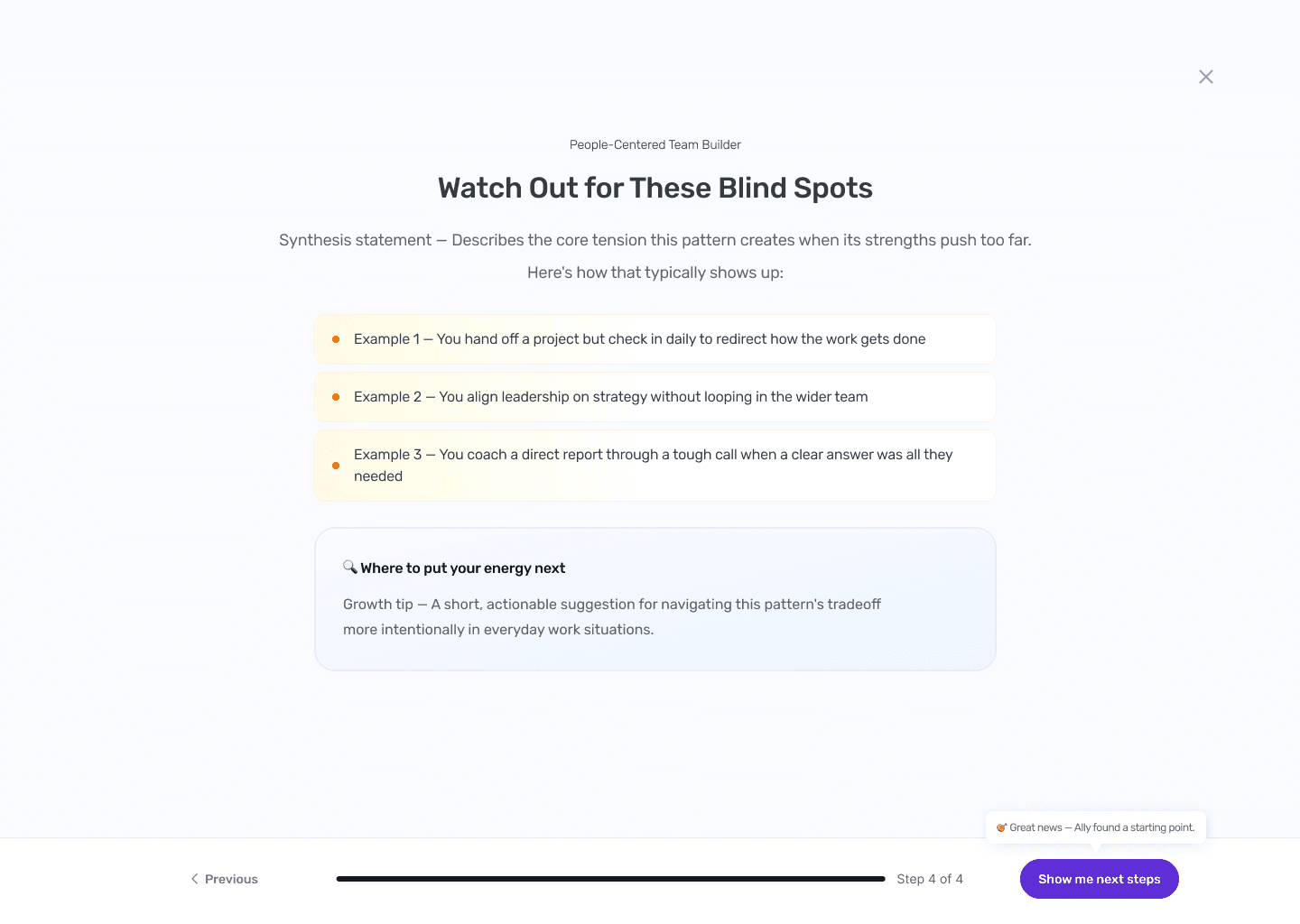
The leadership profile label was absent mid-flow. A user tried to find it and couldn't. The fix wasn't to make it bigger. It was to make it persist quietly: always present, never competing.
10_Outcomes
Shipped. Being measured. Already signaling.
Full activation metrics are being tracked as the feature rolls out to GA.
✅
82%
Followed the narrative from first insight to chosen focus
🎯
36%
Continued the conversation with Ally after completing the debrief
Next phase
Leadership profile surfaces in the home tab as an ongoing personal anchor
🟢 Design is ready and implemented
Let's Connect.
Interested in product design,
behavior change, AI, and building systems that scale.
studiohaena3@gmail.com
linkedin.com/in/studiohaena
See more works
© 2026 Haena Lee